


For the inaugural edition of NAVIIINA’s monthly Alumni Story series, we feature Khadim Batti, Co-founder and Chief Executive Officer of Whatfix, a global enterprise software company driving digital adoption at scale. An alumnus of IIIT-Bangalore, from the 1999-2000 batch of PGDIT Information Technology, Khadim co-founded Whatfix in 2014 with the vision of enabling individuals and organizations to unlock the full potential of technology through intuitive, in-the-flow-of-work digital guidance. With over two decades of experience in building technology-led businesses, he brings a rare blend of engineering depth and entrepreneurial insight. Under his leadership, Under his leadership, Whatfix has grown into a global SaaS leader and evolved into an AI-native enterprise platform. The company operates across the US, India, UK, Germany, and Australia, serving 700+ customers, including 80+ Fortune 500 enterprises. Whatfix has been the top-ranked Digital Adoption Platform in Deloitte’s Technology Fast 500™ for five consecutive years and is consistently recognized as a category leader by Gartner, Forrester, IDC, and Everest Group. Prior to Whatfix, he co-founded SearchEnabler and held leadership roles at Huawei Technologies.
In this conversation, he reflects on his journey from IIIT-B to building a global company, the challenges of entrepreneurship, and his perspectives on the future of AI and digital transformation.
- How did your time at IIIT-B influence your entrepreneurial journey?
IIIT-B played a defining role in shaping how I think, not just what I know. What stood out was the strong emphasis on fundamentals. There was a constant push to go beyond surface-level answers and understand why something works the way it does. That habit of questioning assumptions and thinking from first principles has stayed with me throughout my journey.
This became especially valuable during the entrepreneurial journey. In 2011, we founded Quicko Labs, where our first product was SearchEnabler. In the early years, and later during the pivot to Whatfix, there were many moments when conventional wisdom did not apply, and there was no clear playbook to follow. In those situations, going back to fundamentals and deeply understanding the problem made all the difference.
IIIT-B also fostered a culture of curiosity and experimentation. Being surrounded by people who were constantly building and exploring normalized the idea that it is okay to try, fail, and learn.
In many ways, entrepreneurship is an extension of that mindset. It involves operating in ambiguity, and the ability to stay curious and keep learning becomes a real advantage.
So while my alma mater provided a strong technical foundation, more importantly, it shaped how problems are approached, and that has influenced every decision since.
- What inspired you to start Whatfix, and what problem were you most keen to solve?
The idea for Whatfix came from something that wasn’t working.
We had started Quicko Labs, where our first product was SearchEnabler, an SEO platform for small and mid-sized businesses. On paper, the problem was clear and the solution made sense. But once the product was in the market, the reality was very different.
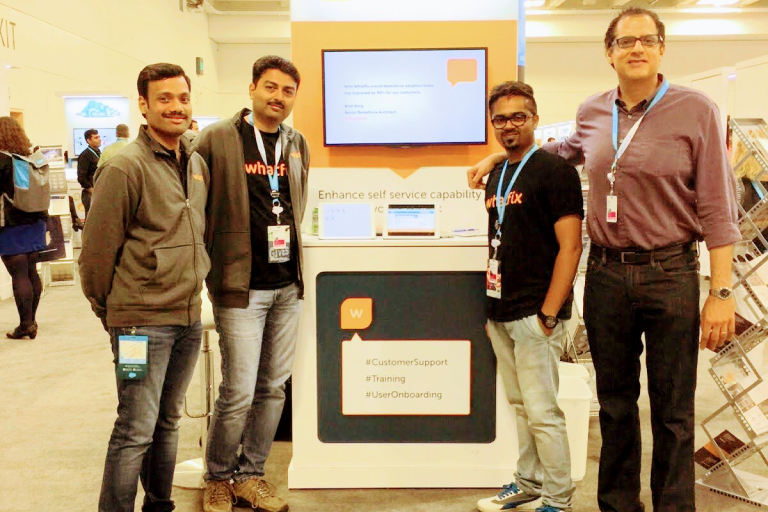
Customers were signing up, but they were not succeeding. Churn was as high as new sign-ups. Conversations with users revealed that the issue was not SEO knowledge. It was usability. They couldn’t effectively use the product and needed constant hand-holding.
That raised a more fundamental question: what problem are we actually solving?
While exploring that, we built a small feature called “Fix It,” a contextual in-app guidance layer. It quickly became clear that this feature was driving the most value. Users were completing workflows, support queries dropped, and engagement improved significantly.
That was the turning point.
The problem was not SEO. It was much broader. The same pattern existed across enterprise software. Companies were investing heavily in technology, but users struggled to adopt and use these systems effectively. Adoption was not failing in training. It was breaking down in the flow of work.
That insight became the foundation of Whatfix.

We made the decision to shut down Quicko and pivot entirely to this direction. The focus shifted to building a platform that helps software adapt to users, instead of forcing users to adapt to software. This philosophy later evolved into what we now call “userization.”
The inspiration did not come from a single idea. It came from failure, customer insight, and the willingness to question assumptions. The problem remains the same today: ensuring enterprise software is adopted, used effectively, and delivers real outcomes.
- What were some early challenges you faced, and how did you navigate them?
The early days were the toughest phase of the journey, both professionally and personally.
The biggest challenge was the decision to pivot. Moving from Quicko to Whatfix meant shutting down the core product and walking away from the only source of revenue. There were paying customers, but the business was not scaling due to high churn.
The decision became even harder because the bet was on a single feature, “Fix It,” which had shown early signs of value. It was the only part of the product where users were consistently succeeding.
There was a limited runway and very little margin for error. A clear deadline was set to validate the new direction. At a personal level, it meant making significant adjustments, including cutting expenses and operating with extreme discipline.
There was also uncertainty within the team. Not everyone was comfortable with the level of risk, and attrition added to the pressure of building something new with fewer resources.
The most difficult part was psychological. There was a real debate about whether to shut down or continue. Both options carried risk.
What helped navigate that phase was going back to first principles. The question remained simple: is this a real problem, and are customers actually struggling with it?
The answer was consistently yes.
Staying close to users made a big difference. Continuous testing, feedback, and iteration helped build confidence. One moment that stood out was at Dreamforce, where early customer feedback on pricing highlighted the true value of what was being built.
That validation helped reinforce conviction.
Looking back, navigating those challenges came down to persistence, customer insight, and the willingness to stay committed to the problem.
- What does sustained growth over the years mean to you as a leader?
For me, sustained growth is less about short-term acceleration and more about consistency and resilience over time.
In the early years, growth can come from momentum or market timing. Sustaining that growth over a decade requires discipline in both product and organizational decisions.
One of the early decisions was to separate how customers are acquired from how they are expanded and retained. This led to a structured model across new business, customer success, and expansion. That clarity ensures customers continue to see value long after the initial sale.
A key part of sustaining growth has been staying anchored to a core philosophy. At Whatfix, that is userization. The idea that software should adapt to users, not the other way around, emerged from firsthand experience of seeing customers struggle with software. Over time, it has shaped product decisions, expansion strategy, and how new opportunities are evaluated. Today, a significant portion of the product pipeline is driven directly by customer feedback, ensuring innovation stays grounded in real workflows.
Sustained growth also requires saying no. Not every opportunity aligns with long-term goals, and discipline in decision-making becomes critical.
As a leader, the focus is on building systems rather than relying on individuals. Growth needs to be embedded into how the organization operates through clear ownership, structured processes, and consistent decision-making.
This becomes even more important during periods of uncertainty. Staying focused on customer value and continuing to invest in innovation helps maintain long-term direction.
Ultimately, sustained growth reflects consistent value creation. When that is strong, everything else follows.
- How do you see the future of digital adoption and technology evolving?
The future of digital adoption is closely tied to how digital transformation evolves. Enterprises have invested heavily in technology, but many still struggle to realize full value, not because of the technology itself, but because of how effectively users adopt and use it.
Digital adoption has already moved from one-time training to continuous, in-the-flow-of-work support. Today, users receive real-time guidance, can practice in safe, risk-free environments, and organizations gain visibility into where users face challenges, helping them continuously improve outcomes and close the adoption gap.
Looking ahead, this will become more intelligent and proactive. Systems will not just guide users, they will recommend next steps, prevent errors, and support execution within workflows. AI will play a central role in this shift, connecting guidance, training, and analytics into a more unified and responsive experience.
At the same time, trust and control will become critical. As systems take on a more active role, enterprises will need transparency, governance, and clear oversight into how work is performed.
Ultimately, the goal is to make digital transformation work in practice by combining intelligent, in-context support with the visibility and control needed to drive consistent, measurable business outcomes.
- What advice would you offer to students and aspiring entrepreneurs today?
One of the biggest lessons is to start with the problem, not the solution.
Technology is evolving rapidly, and it is easy to get excited about ideas. But real impact comes from solving meaningful problems. Spending time with users, understanding how they work, and identifying friction points is critical.
The second lesson is to be comfortable with uncertainty. The journey is not linear, and there will be phases where things do not work and outcomes are unclear. In those moments, what matters is not having all the answers, but continuing to move forward.
Over time, four traits become especially important:
- Curiosity to explore
- Discipline to execute
- Perseverance to push through challenges
- Intellectual honesty to recognize when something is not working
Some of the most important decisions come from realizing that initial assumptions were wrong and having the courage to change direction.
Success does not come from having the right idea at the start. It comes from staying committed to solving the right problem.
- How do you view AI as an opportunity or a challenge for Gen Z?
AI is one of the most significant opportunities for this generation, but it comes with responsibility. It can accelerate learning and productivity, enabling faster experimentation and access to knowledge at scale.
What makes this moment unique for Gen Z is that it coincides with the phase where creative identity is formed. This is typically when people experiment, fail, and discover their voice. AI can shorten that process if used too early or without intent, especially with the pressure to produce polished outcomes.
The key question is whether AI becomes a crutch or a collaborator.
The difference comes down to having a point of view. Those who know what they want to say use AI to get there faster. Others risk letting it shape their thinking. AI acts as an amplifier. It increases the importance of critical thinking, creativity, and judgment.
The real opportunity is learning how to work with AI in a way that strengthens these fundamentals.
AI should help express a voice, not replace it.