

Article by Commodore SR Sridhar (Retd), Registrar, IIIT-B
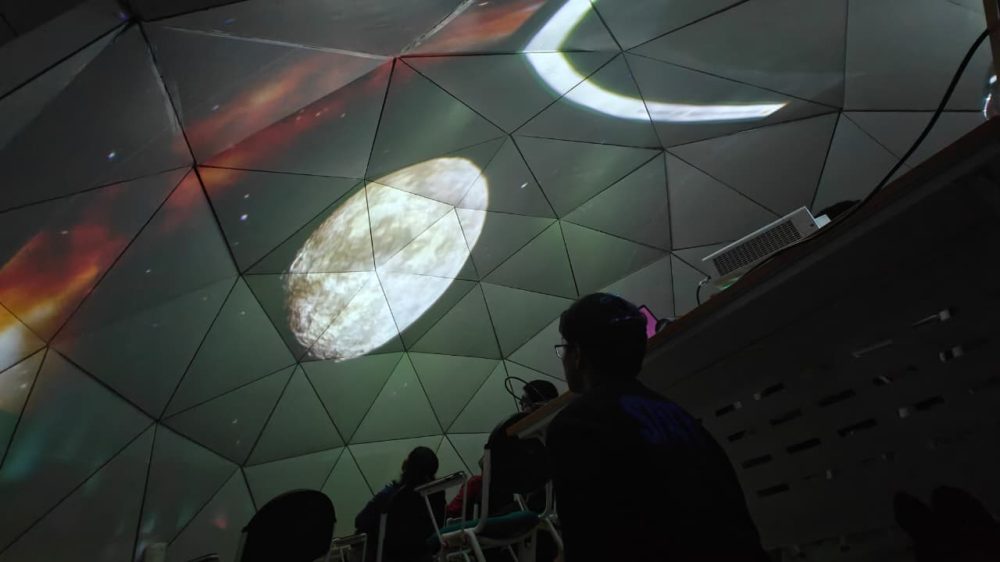
The recently concluded Synergy Tech Fest at IIIT-B had plenty to offer, but the undisputed star of the event was the Planetarium, built entirely by the student members of ECLIPSE, the Astronomy Club of IIIT-B. Constructed with their own hands and endless enthusiasm, the Planetarium showcased two beautifully produced shows. As the lights dimmed, the dome transformed into a boundless night sky — meteors streaked past, planets shimmered in orbit, and the soothing narration carried us on a breathtaking voyage through the universe.
Before I even begin to describe this remarkable feat of science and craftsmanship, I must first talk about the Astronomy Club itself — the passionate minds behind it. My curiosity to learn more about them was perhaps inevitable, given my Navy background. Astronomy has always held a special place in my heart, thanks to the astro-navigation I practiced decades back during my naval tenure. I could easily relate to the sense of discipline, teamwork, and quiet wonder that must have driven these students to create something so extraordinary.
The Astronomy Club at IIIT-B began rather informally in 2022, when a few like-minded students started meeting to discuss the stars and the mysteries above. For Divyam, a research scholar, these gatherings became a welcome runway to the celestial world — a refreshing escape from the intense cognitive demands of deep research and paper writing. “Amid all the coursework, assignments and research–It was our little escape to the universe,” says Divyam with a lot of josh, his enthusiasm infectious as he recalls those early days. In the beginning, the club’s meetings felt almost secretive; a handful of us would gather on the terrace of the Multi-Purpose Hall, which offered a perfect open sky for stargazing. The spot, complete with a few thoughtfully placed sofas, became our little observatory. To the rest of the students, our conversations filled with terms like Ursa Major, Ursa Minor, and Orion must have sounded like Greek and Latin — but for us, it was a language of wonder. Overtime, now the club is equipped with a dobsonian newtonian telescope with a 10 inch aperture which allows observation of stars and planets depending upon the night sky for the date.
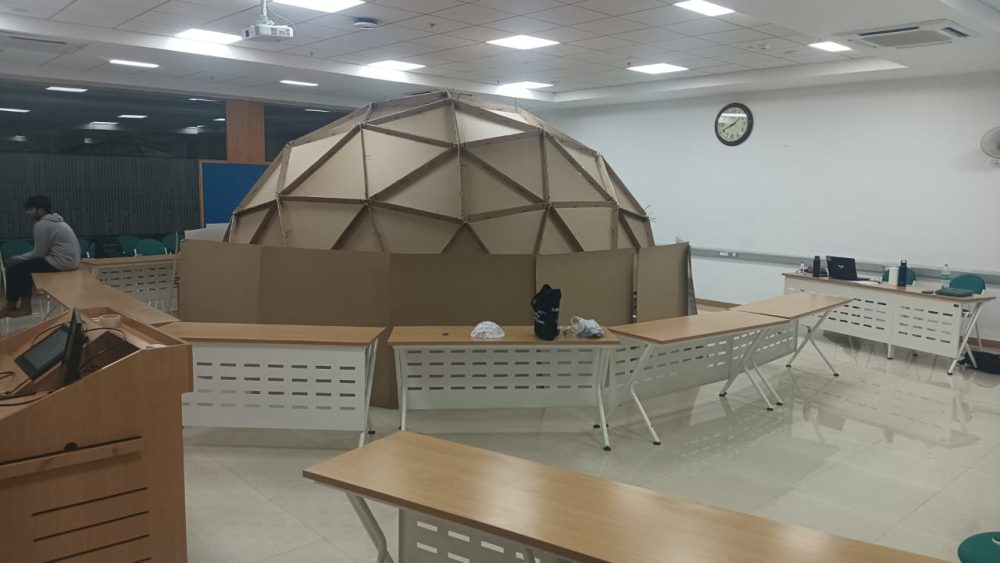
The Planetarium itself was a marvel of student ingenuity. The Astronomy Club members built a geodesic dome entirely out of cardboard, a feat that combined creativity, geometry, and teamwork in equal measure. The idea took shape after the students came across a similar effort by the Astronomy Club at NITK Surathkal, but in true IIIT-B spirit, they decided to push the boundaries further. The result was a majestic eight-foot-high dome, larger and structurally more refined than the original inspiration.
What made the structure truly fascinating was the mathematical precision behind it. The students began by designing 2 isosceles triangles with sides A (33.5 inches) and C (39.6 inches) and a common base side B (38.7 inches)—AAB, CCB—to serve as the fundamental building blocks of the dome. These triangles were then joined edge-to-edge to form half-hexagonal and pentagonal panels, carefully calculated so that each angle met perfectly at the vertices. The dome followed the principles of geodesic geometry, where the curvature of a sphere is approximated by a network of flat triangles. The strength of the design lies in this triangular tessellation—each joint distributes stress evenly, allowing even lightweight materials like cardboard to bear significant structural load without warping.
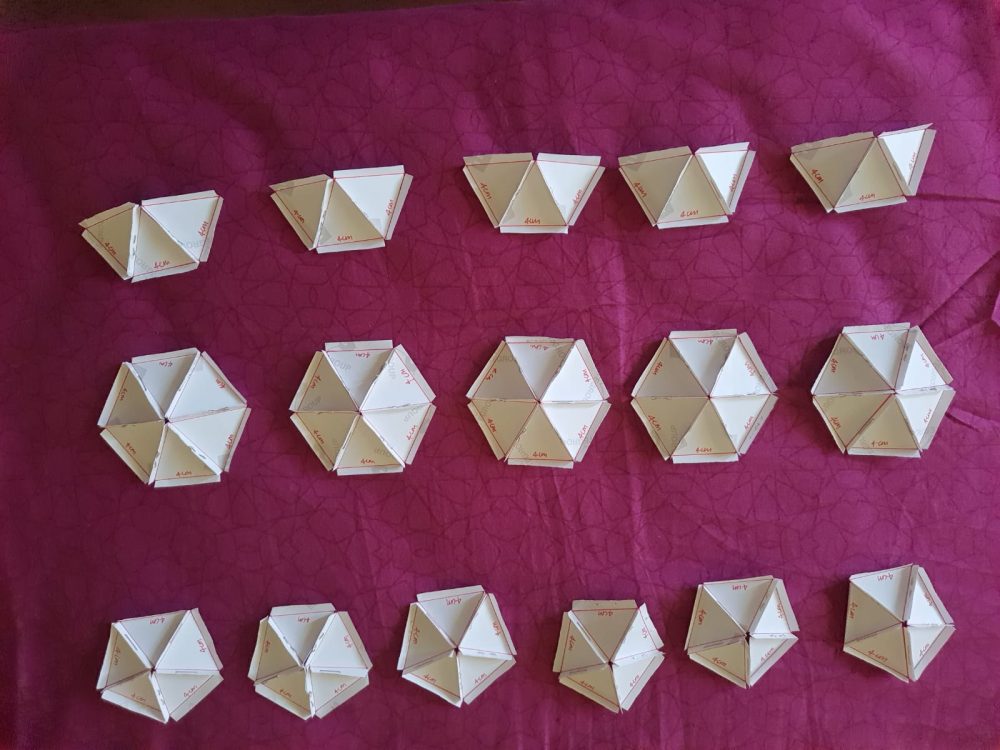

Before committing to the full-scale version, the team built a miniature paper prototype to test their measurements and assembly sequence. Once confident, they scaled it up—cutting, numbering, and assembling dozens of triangular pieces with remarkable precision. Piece by piece, the triangles locked together, and what began as flat sheets of cardboard gradually rose into a self-supporting hemispherical dome. Watching them describe the process, I couldn’t help but admire the blend of engineering discipline and artistic craftsmanship that went into the build. It was as if a constellation of effort and imagination had taken solid form—bringing the universe a little closer to us.
The ingenuity didn’t stop at building the dome. Once the structure stood complete, the students turned their attention to what would truly bring it to life — the projection system. In a wonderful display of resourcefulness, they sourced a convex mirror half dome (quarter sphere) from a traffic equipment vendor, and ingeniously used it to reflect visuals from the institute’s digital projector onto the curved inner surface of the dome. The setup transformed an ordinary projector into a planetarium-grade visual system. The convex mirror allowed the light to spread evenly, wrapping the entire inner surface with a seamless, immersive sky. It was a perfect example of how scientific creativity often thrives under constraint — where limited resources spark extraordinary solutions.
While one group worked tirelessly on the technical arrangement, another team of students poured their hearts into creating the shows themselves. They scripted, recorded, and edited two stunning presentations that would later leave audiences spellbound. The first, titled “Wonders of the Solar System,” took viewers on a guided journey through the planets — from the scorching plains of Mercury to the icy edges of Neptune — with breath-taking visuals and a narration that felt both informative and poetic. The second show, “Knights of the Winter Sky,” was an ode to the constellations that dominate the northern hemisphere during the colder months. Under the soft glow of projected starlight, familiar figures like Orion and Cassiopeia came alive as celestial guardians of the night, their myths and science interwoven seamlessly.
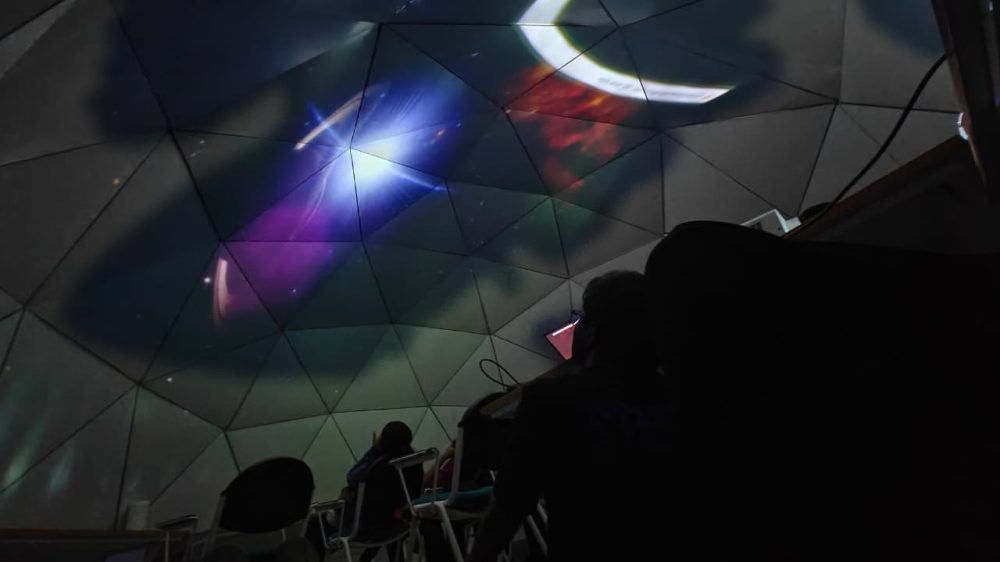
As I settled inside the dome, I noticed the thoughtful touches the students had added. They had arranged soft beddings on the floor, allowing about eight spectators to lie back comfortably and gaze upward at the vast celestial expanse unfolding above. When the lights dimmed and the first stars appeared on the curved surface, the illusion was complete — it truly felt as if we were floating beneath a living night sky. As “Knights of the Winter Sky,” unfolded, I found myself drifting into memory. It reminded me of my training days in the Navy, when we were once set adrift on the open sea on a new moon night, with no compass or navigation instruments — only the stars above to guide us home. Beneath that vast, starlit silence, I had first learned to trust the heavens. Sitting now under this student-built dome, watching those same constellations glow once more, I felt the circle complete — the same stars that once led me to shore were now leading a new generation toward discovery.
Credits:-
Design and Planning:
- Divyam Choudhary (MS2022011)
- Harshvardhan Mishra (BT2024251)
- Tahir Khadarabad (IMT2022100)
- Sayak Chowdhury (MS2023012)
- Lohitaksh Maruvada (IMT2022536)
Building Planetarium:
- Pasham Godha (BT2024082)
- Shivam Pandya (IMT2023091)
- Rohan Kamath (BT2024238)
- Amartya Varahala (IMT2024085)
- Aarav Choudhary (IC2025002)
- Aryan Thumula (BC2025015)
- Huma Khadarabad (IE2025017)
- Siddha Dhok (IE2025010)
- Karma Patel (BE2025020)
- Samarth (IE2025030)
- Tarun Kondapalli (IMT2022034)
- Anay Datta (BE2025003)
- Devbrat Singh (BE2025010)
- Jeswin Jose (BT2024142)
- Surya Kiran (BC2025099)
- Prasiddh Tilala (BC2025077)
Planetarium Movies:
- Arjun Sai (+voiceover on both movies) (BT2024001) \[Wonders of the Solar system\]
- Devansh Dhoka (IC2025012) \[Knights of the Winter Sky\]
Ably guided by Prof Shiva Kumar Malapaaka and Mr Kannan